



C-15 3rd Floor, Amar Colony Main Market,
Lajpat Nagar - 4,
New Delhi - 110024, India
Types of SSL Certificates
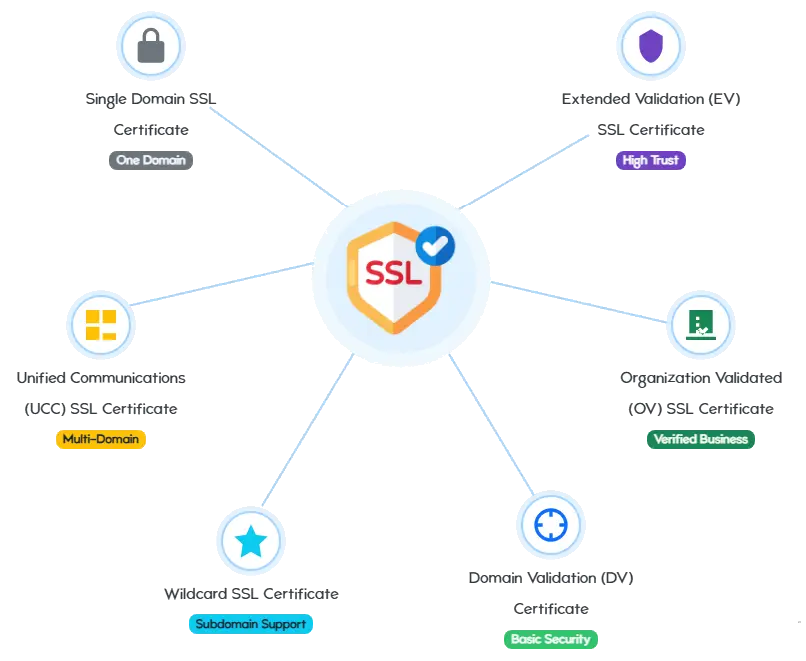
A simple breakdown of Domain, Organization, and Extended Validation certificates.
By estimated usage
SSL/TLS certificates provide the essential secure, encrypted connection (HTTPS) between a user's browser and a server. However, they differ significantly in the level of identity assurance they provide. Choosing the right certificate ensures data security and builds customer trust by verifying who is behind the website.
Verifies ownership of the domain name only. Fastest issuance time.
Verifies the domain *and* the legitimacy of the operating organization.
The most rigorous validation process, ensuring maximum customer confidence.
Choosing between certificates often looks straightforward at first. Price, validity, maybe brand. Then the questions start. Compatibility with hosting. Type of validation. Renewal timelines. Many businesses begin with a ssl certificate comparison service, but quickly realise the decision doesn’t sit alone. The certificate has to fit into an existing setup. Or sometimes, a setup that is still evolving. What tends to happen is small gaps appear during implementation. Mixed content warnings. Improper redirects. Unexpected browser flags. Not major issues individually, but enough to affect trust. In practice, certificate decisions often lead into broader adjustments. Server configurations get revisited. Security settings need alignment. Even performance can come into the conversation. So while comparison is the starting point, it usually opens a few more areas worth looking at. Quiet dependencies that don’t show up in a feature list, but matter once things go live.


Some teams arrive with a shortlist already. They’ve compared options, just need clarity before moving ahead. Others are unsure where to begin. Too many choices. Similar pricing. Not much difference on the surface. There are businesses handling sensitive user data, where even small decisions carry weight. Then there are early-stage teams setting things up for the first time, trying not to overcomplicate it. In a few cases, things were already implemented. Not incorrectly, just not suited to how the business evolved. The situations vary. The starting point shifts. The need for clarity tends to stay.
The "padlock" is just the baseline now; it doesn’t mean your business is legit. DV (Domain Validation) is basically a background check on a website's existence—it takes 5 minutes and costs next to nothing. But if you’re a real company in Bharat, you need OV (Organization Validation) or EV (Extended Validation). That’s where a human at the Certificate Authority actually verifies your GST or trade license. It’s about "Identity." If I’m giving you my credit card, I want to know Jingle Infotech is a real office, not a ghost in a server farm.
Short answer: No. Long answer: It’s not about the math, it’s about the "Warranty" and the "Handshake." A premium Entrust or DigiCert certificate has a much higher "Financial Warranty"—if the encryption actually fails and you lose money, you’re covered for up to $1.5 Million (approx. ₹13.8 Crores). Try getting that from a free "Let's Encrypt" bot. Plus, premium certs have faster OCSP response times. We’re talking a 200ms difference in how fast your site loads. In the e-commerce world, that’s the difference between a sale and a bounce.
Because your time is worth more than the ₹5,000 ($54) you think you're saving. A Wildcard SSL covers *.yourdomain.com. One certificate. One renewal date. One installation. If you buy individual certs for your mail, your portal, and your shop, you’re basically signing up for a "renewal headache" every few months. We’ve seen businesses go dark because they forgot cert #4 of 5. For about ₹25,000 ($270), a Wildcard is basically "sanity insurance."
Think of it as a "Bundle." If you own jingleinfotech.com and jingle.in, you can put them both on one SAN (Subject Alternative Name) certificate. It’s surgical. It’s perfect for companies running different brands on the same server stack. It saves on IP addresses and simplifies your "Handshake" logic. We usually recommend this for our enterprise clients who are juggling 3 or 4 different regional domains but want to manage security from one central dashboard.
Most people ignore the fine print until they get hacked. That warranty isn't for "site hacks"; it’s for "Certificate Failure." If the CA (Certificate Authority) messes up and allows a hacker to spoof your site, that $100,000+ (roughly ₹92 Lakhs) warranty is your safety net. For a small blog? Doesn't matter. For a payment gateway or a portal handling sensitive KYC data? It’s non-negotiable. Don't be "penny wise and pound foolish" when it comes to your legal liability.


Fill out the form and our team will get back to you shortly. We are here to help you with your queries and support.
Get in touch